
The Thompson Speedway Motorsports Park Driving Experience
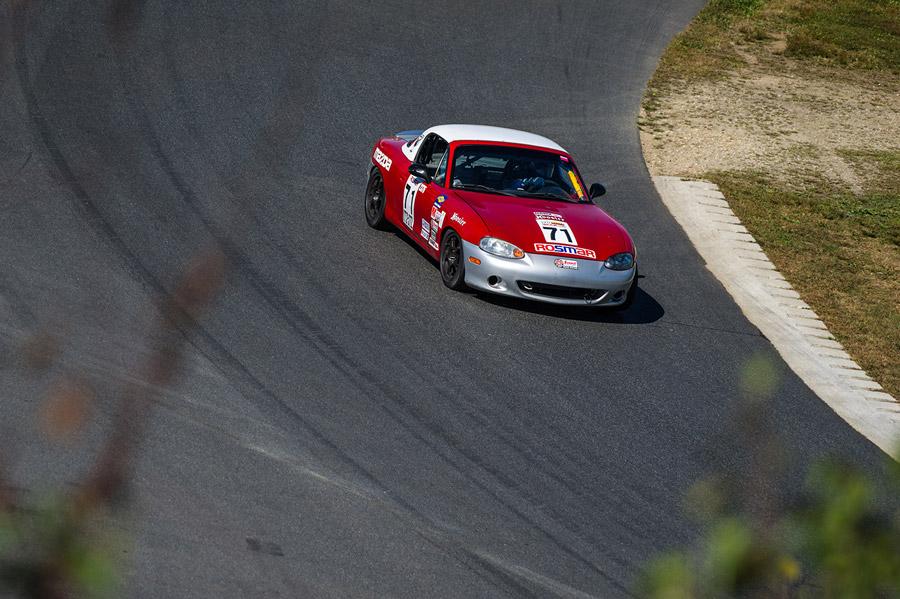
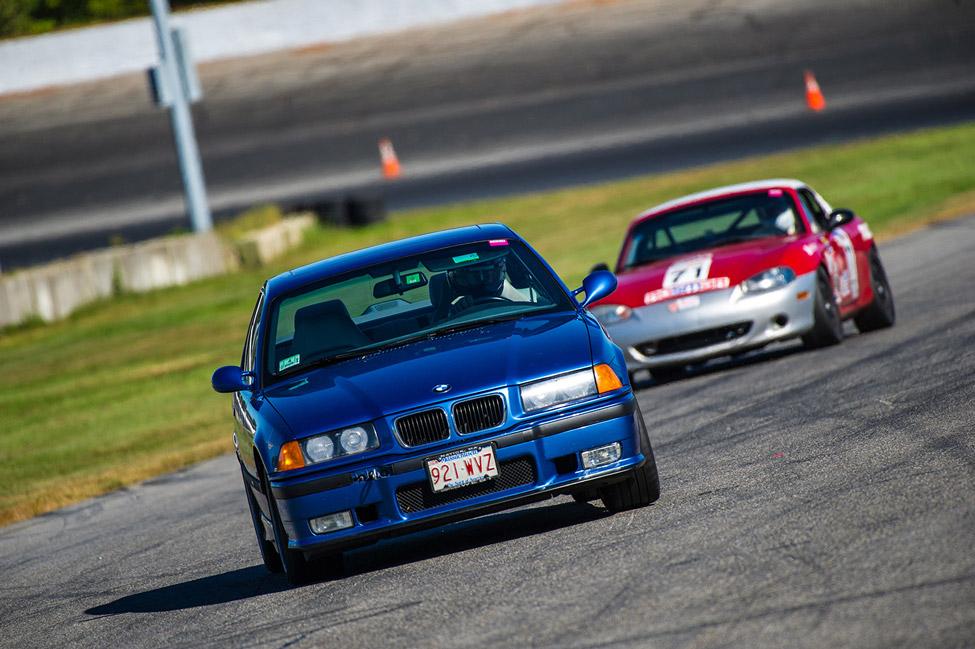
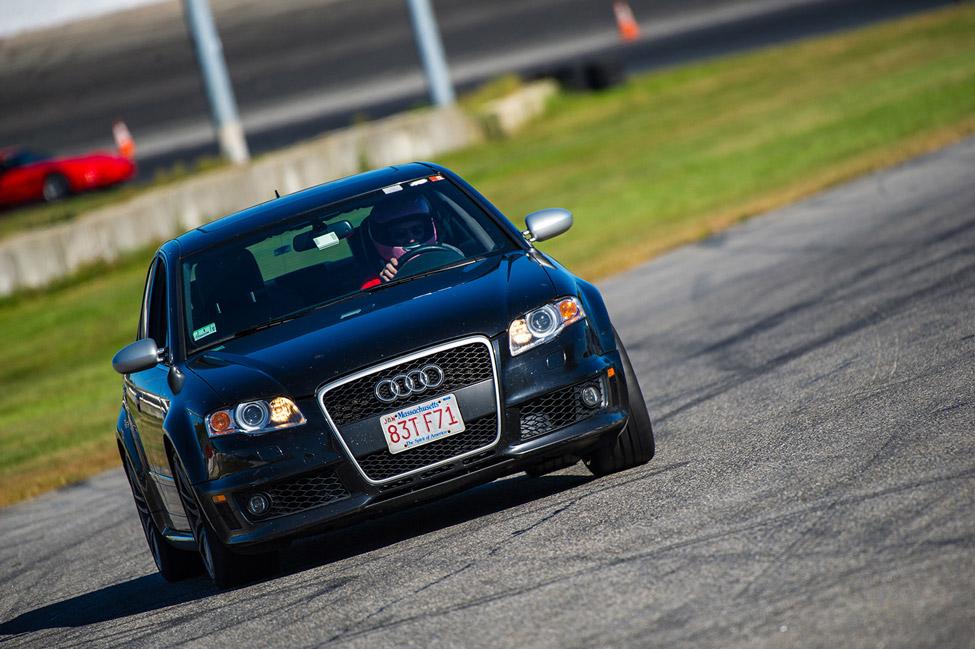
 The SCDA will host events at Thompson Speedway Motorsports Park this season! This 1.7 mile road course has a nice mix of straights, challenging corners and some elevation changes. The pavement is brand new and the runoff areas are very forgiving. Located in Thompson Connecticut, this beautiful motorsports facility is a track that you must plan to drive.
Highlights of an SCDA Event at Thompson Speedway Motorsports Park
- Repaving of the historic 1950’s 1.7 mile road course to 38’ wide, new curbing
- Upgrade to modern safety standards, adequate run off areas and modified turn design to accommodate modern racing and driving needs.
- A 110’ span bridge that will accommodate hauler traffic in and out of the paddock area
- Thirty stall garage building
- New classrooms, offices, restrooms, timing and scoring tower, concessions stands
- Autocross and skid pad area
- New entrance and registrations building
- Upgraded safety fencing and barriers
- Upgraded New England Race Fuels/ Sunoco fuel station.
- Participants can expect four on track drive sessions, one on one In Car Instruction if needed, and two Classroom Sessions. In an effort to provide maximum levels of safety, quality, and fun at our events, the SCDA will provide trained and certified flaggers at the corner stations. This ensures that our drivers can focus on one thing- improving their driving skills. This event is geared towards all skill level drivers, from Novice to Advanced.
- A limited number of arrive and drive rental Spec Miatas are available for this event.
- SCDA Data and Video Coaching- SCDA is offering professional data and video coaching at our events. This is an affordable and individualized program that will help you take your driving to the next level. Our coaches are accomplished racers and industry experts that are able to pinpoint areas for improvement. Together you’ll come up with an action plan to help you achieve your goals.
- Garage Bays are available for rent.
2026 SCDA Schedule of Events at Thompson Speedway Motorsports Park
The SCDA dates at Thompson Speedway Motorsports Park in 2026:
April 4th, May 2nd, June 22nd, July 19th, September 12th, October 18th
- Thompson Speedway Motorsports Park Full Day Schedule (SAMPLE- subject to change)
- 4-4-26 Thompson Speedway Motorsports Park Schedule
- 5-2-26 Thompson Speedway Motorsports Park Schedule
- 6-27-26 Thompson Speedway Motorsports Park Schedule
- 7-19-26 Thompson Speedway Motorsports Park Schedule
- 9-12-26 Thompson Speedway Motorsports Park Schedule
Event Price
All Thompson Speedway event entry fees are $449 retail ($599 for novice group, includes instructor for lead/shadow or in car based on restrictions and/or request).
Save $50 and pay only $399 for one day if you register 2 months prior to the event.
Save $25 and pay only $424 for one day if you register 1 month prior to the event.
Thompson Speedway Motorsports Park- Turn by Turn Track Guide
Thompson Speedway Motorsports Park- Turn by Turn Track Guide
Thompson Speedway Motorsports Park – Turn by Turn Track Guide
1.7 Mile Lap
T1 – Keeping tight to the left approaching the brake point, we will utilize the number boards driver’s left as a reference for braking point. Brake early and hard with the goal of overslowing the speed by turn in, and if successful, incrementally move the brake point later by no more than ¼ number board at a time. The brake zone has a small elevation gain at about the 3 board, and a slight downhill by turn in. This is a trail braking corner, gradually reducing brake pressure in proportion to steering input in. Get the eyes up early and be patient with initial throttle until the eyes tell us that the trajectory through the apex is such that steering can be gradually reduced. Stay off the apex curb here as it will bounce the car too much. The exit curb is usable so long as the steering is in the process of straightening. Typically a 2nd or 3rd gear corner, if the corner is taken in 2nd then a slow, smooth upshift to 3rd is required just after exit.
T2 – Beginning from the very left side of the road, alongside the track out point of T1, we can begin a smooth throttle squeeze as long as our eyes are up the road and we understand the trajectory of the car. The priority for T2 is to have the car on the very right side of the road with balanced suspension in preparation for T3. This means some of the higher horsepower cars will need to delay throttle squeeze and continue to turn, whereas some lower horsepower cars may have the ability to still steer under acceleration. Set the angle of the rudder (steering wheel) and adjust the submersion level (how deep the rudder is in the “water”) with smooth adjustments with throttle.
T3 – This corner appears tighter than it is at corner approach, and as such a common mistake is leaving additional room to track out. It does make sense to begin with a late, sharp turn in, oversquaring the corner and having too much room at track out. Over time, and using reference points, we can begin to incrementally adjust our turn in earlier and earlier and monitor what happens at corner exit. Steering wheel position should always be a gradual release after the apex, and if you find yourself “stuck with steering” after apex there’s a good chance to turn too early. Either way, eyes up early here, and a longer medium brake is preferable over a shorter harder one. Keep the break release smooth here, and only accelerate once your eyes tell your hands they can straighten.
T4 – This is a great place to practice “string theory.” That is, the hardest brake being initially and with a straight steering wheel, followed by a gradual reduction in brake pressure proportional to addition of steering. Further, a brief pause between brake release and initial throttle (coasting) and then a proportionate squeeze of throttle in proportion to steering removal coming out of the corner. As always, only begin acceleration once the eyes tell the hands they can straighten coming out of the corner.
T5-6 – Think of T5 as before the overhead bridge and T6 after the bridge. This essentially is one big corner, with a double apex philosophy, but with one caveat. Stay ½ car width wide of the first apex (T5), float to center track (under bridge) and then tighten hands for additional direction change into the apex of T6. There is an element to braking *reasonably* deep here to properly load the front tires, but the brake point must be snuck up on incrementally. You will be braking and turning at the same time, meaning a smooth brake release is especially important. Brake release should occur just before going under the bridge, and you must be patient on initial throttle. At corner exit, there is a surface change, a transition to off-camber (road leans against your favor) and the corner tightens up subtly geometrically. 3 things that want to push the car too wide too early. Critically important to get the eyes up, understand your trajectory sooner than later, and only squeeze throttle once steering is straightened.
T7-8 – Essentially a longer duration 180 degree corner, think of T7 as being the way into the corner and T8 being the way out of the corner, with the brake occurring right in the middle. There are two major transitions in this corner complex, one coming from the oval back onto the apron, and the other transitioning back onto the oval coming out of the corner. Approaching T7, you want to be about a car width away from the wall on the left, following the angle of the cones driver’s left. Our brake wants to be longer and medium, not late and hard. This retains our ability for accurate car placement. The brake release should happen just before the car falls onto the apron, raising the nose as it simultaneously compresses into the flat pavement. There should be a fairly long duration maintenance throttle in this area, as the car has less grip on the apron. The apex is just after the access road on driver’s right, and you want to hold the apex curb for 4-5 car lengths. Only leave the apex once you are sure your trajectory out of the corner is good. You do not need to track out all the way here, if you leave the apex early and track out against the wall you hit the transition from apron to oval at a more perpendicular angle, upsetting the balance of the car. Holding the apex a tick longer and then releasing, the car is more parallel at this transition.
T9 – On approach, position the car ¾-⅞ of the way to the right side of the road, no need to use all the road on the right on the way in. There is a significant transition from the oval onto the outfield course, as such a longer medium brake is preferred over a shorter harder one. At the moment of this transition, the left side tires want to be ½ car width off of the left side of the track, aiming to be tight, but slightly wide at the “triangle” of the concrete, pavement and grass. Let the car float to the middle of the road under the medium brake, and then smoothly relax brake pressure and turn in hard to the apex alongside the curb to be properly set up for T10, this is priority here. It’s tempting to look too straight too long here, so be mindful to turn the head left, possibly even looking out driver’s window (frame of reference not limited to windshield)
T10 – This corner is a short duration, right hand corner. It comes up quickly after the apex of T9, and a very soft brake is beneficial here even if you can get away with just a lift. This “digs” the left front into the road better to accept a later, sharper turn in to get the car to change direction. The apex curb here can be beneficial, opening up the corner a little bit. Just make sure you are on a light throttle to get the car “nose up” going over the curb. You can use the exit curb here, so long as you’re in the process of unwinding the steering.
T11 – This is a fast, longer duration right hand corner. The speed adjustment is typically just a lift. On corner approach, begin with an early lift, a longer coast period, and a return to maintenance throttle at turn in. Over time, you can work the speed adjustment post turn in, but this will require precision and smoothness. The turn in airs on the side of late, sharp and quick hands. It’s good to get the car to change direction and a slightly later apex here, as the road keeps bending to the right. If you find yourself not challenging the track out here, don’t sweat it, you don’t need to track out all the way here. Over time, if you do want to challenge the exit, you will do so only with momentum through the apex, and NEVER through unwinding steering, and being forced to re-add it. You always want to keep the suspension “loaded up” by keeping steering in here even if it means you don’t track out all the way.
T12 – This is the “hump” in the road coming up to the front straightaway. Be mindful of the slope of the road here. On compression, the car gains grip potential. But on the crest, it loses grip potential. Position the car in such a fashion that there’s room to remove steering going over the crest. This typically means steering a little more on the compression (the upslope) of the hill, in anticipation of the straightening of the hands going over the crest (downslope).
Author: Jonathan Goring
Pro Driver Coach
www.jonathangoring.com
Want an analysis on your own driving? Check out Jonathan Goring’s Remote Coaching page for more information on purchasing a Driver Performance Analysis Session of AiM, Vbox or Garmin files.


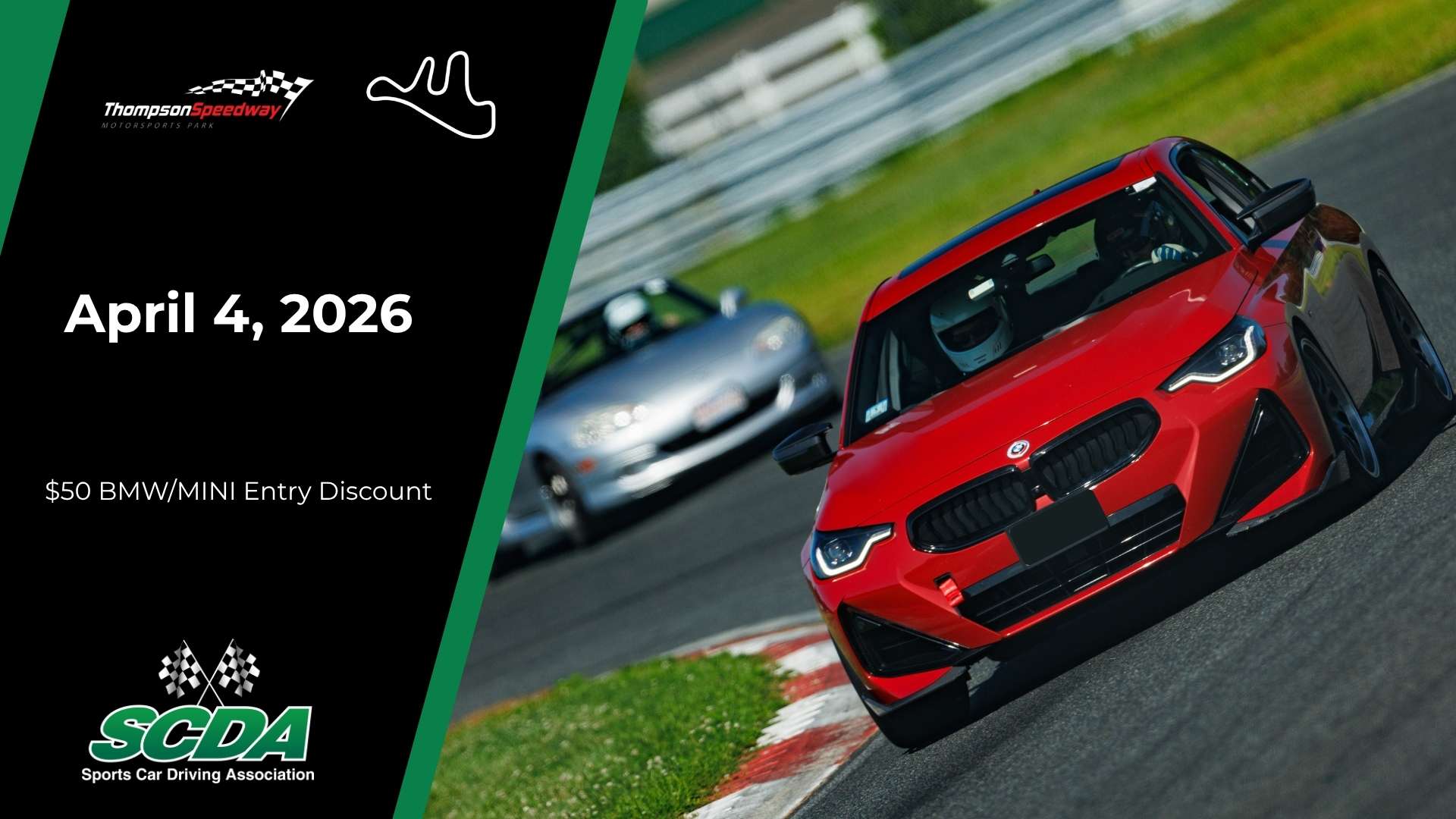
SCDA Thompson Speedway Track Day- April 4, 2026
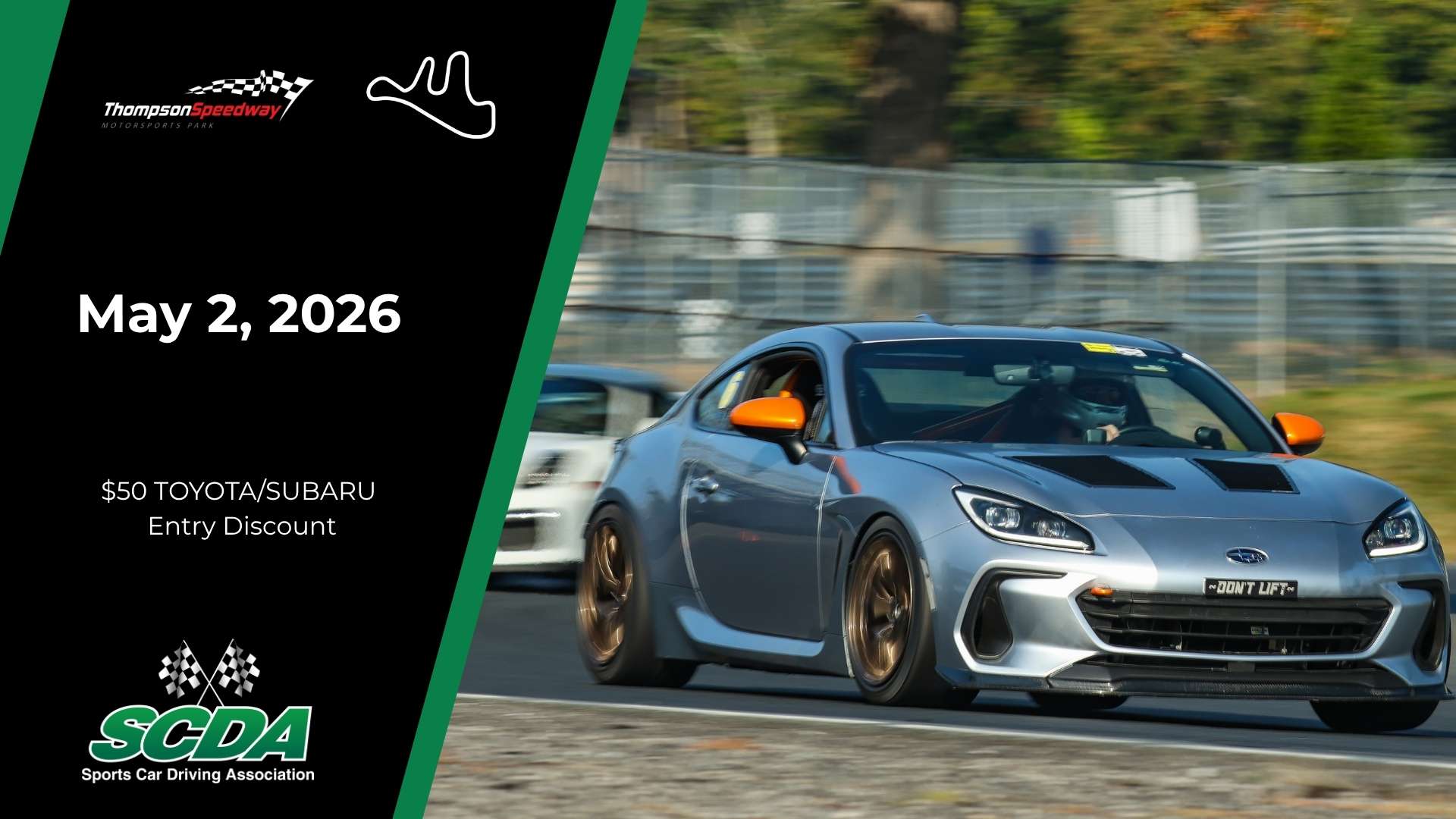
SCDA Thompson Speedway Track Day- May 2nd, 2026
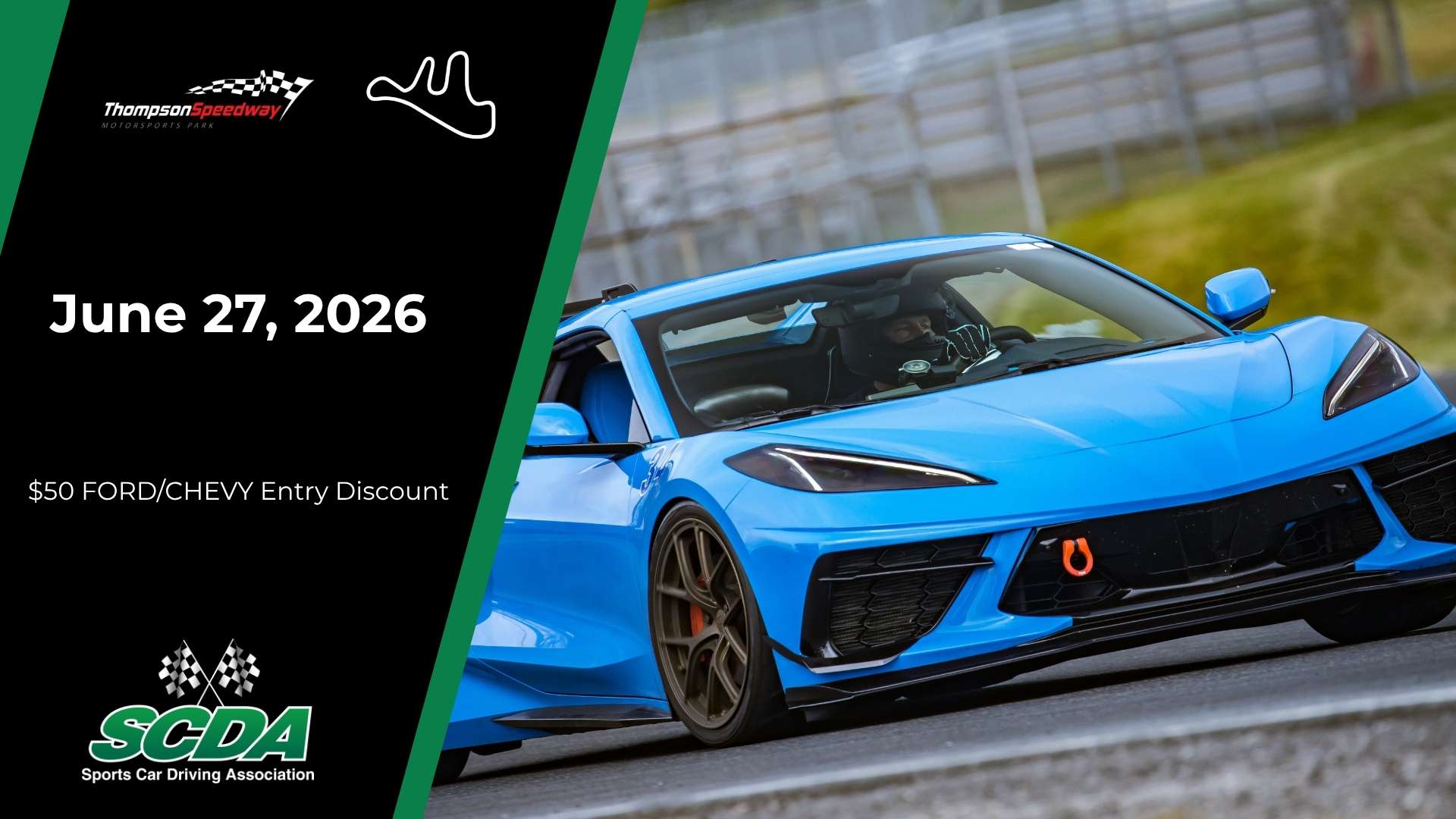
SCDA Thompson Speedway Track Day- June 27, 2026
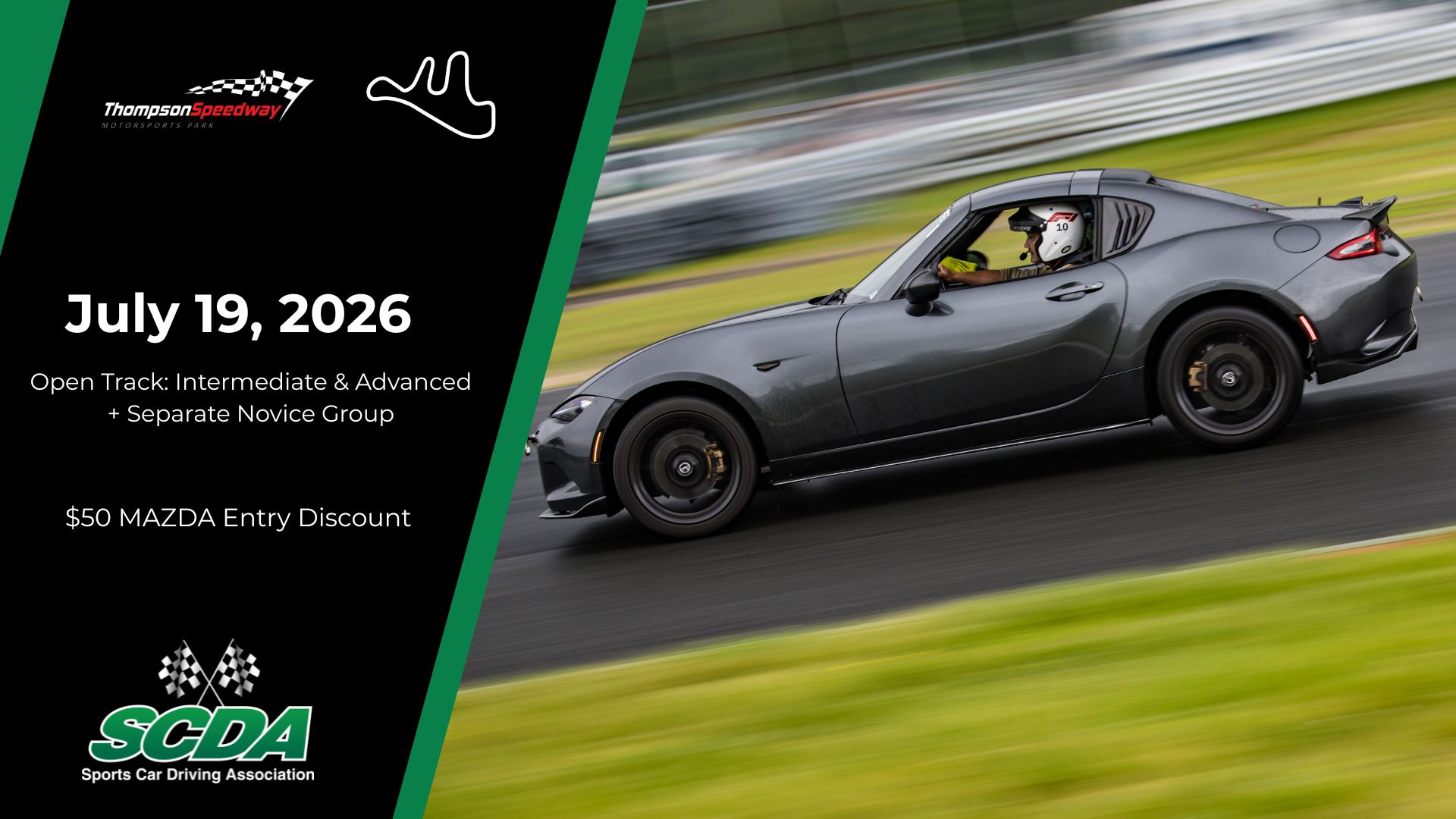
SCDA Thompson Speedway HPDE + Open Track Day

SCDA Thompson Speedway Track Day- Sept. 12, 2026
SCDA Thompson Speedway Track Day- Sept. 12, 2026
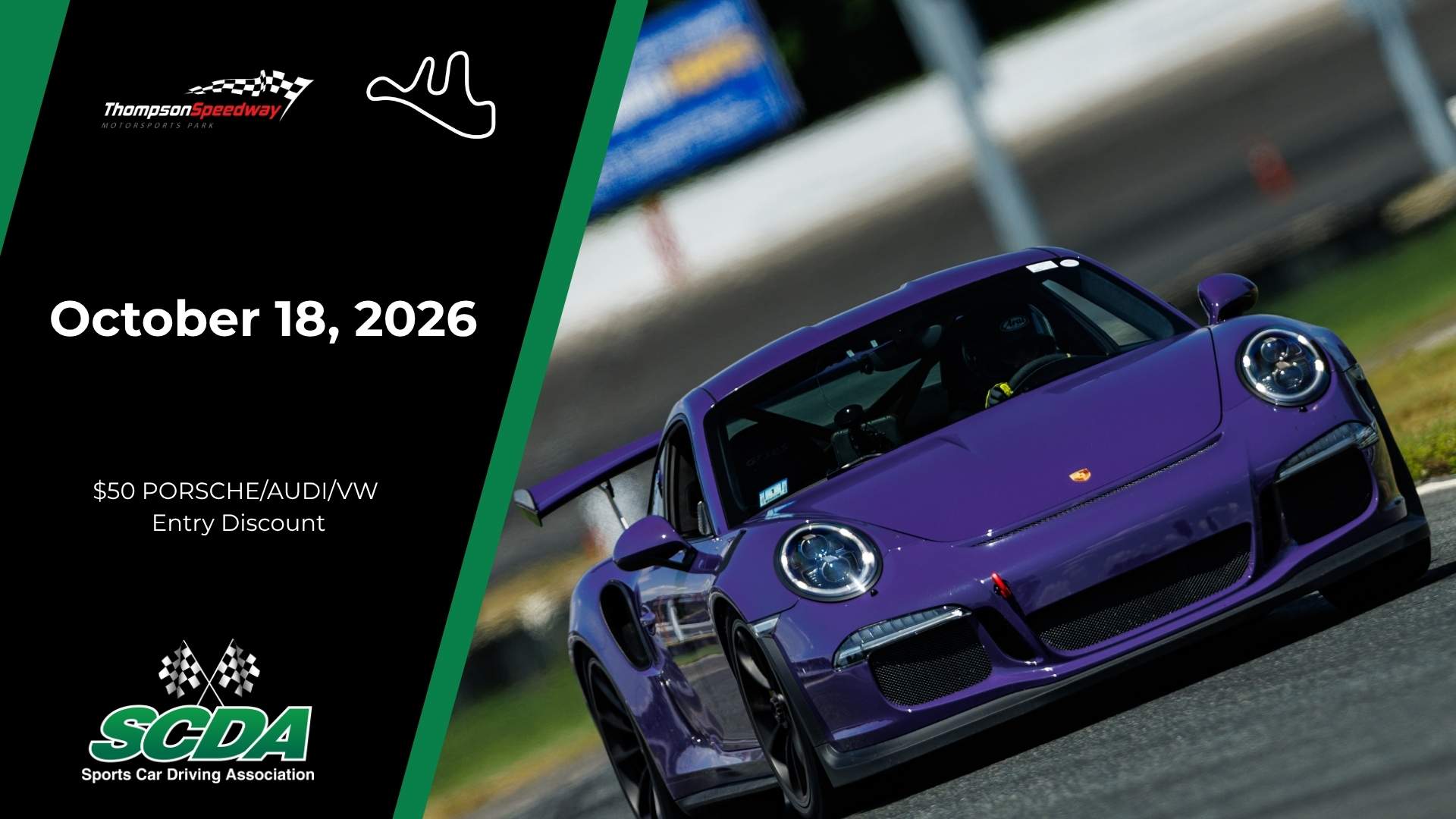
10-18-26 Thompson
Track and Event Information
Location / Directions
Direction to Thompson Speedway Motorsports Park
Directions to Thompson Speedway Motorsports Park
GPS Navigation:
205 East Thompson Rd.
Thompson, CT 06277
Phone: 860-923-2280
TSMP Policies
Thompson Speedway Motorsports Park Policies
2018 THOMPSON SPEEDWAY MOTORSPORTS PARK
GENERAL RULES AND REGULATIONS
To ensure that all guests have a safe and enjoyable visit to TSMP, the following rules
and regulations are in effect.
Entry & Admittance
All individuals must have the proper credentials for the area(s) they are seeking access
to.
Children under the age of sixteen (16) must be accompanied by an adult while in the
paddocks. For their safety and that of others, children must be kept under adult
supervision at all times.
Persons under eighteen (18) years of age are not permitted in the hot pits or at corner
stations.
TSMP allows pets at its events; however all pets must be leashed and cleaned up after.
Pets are not permitted in hot pit areas
TSMP shall have the right, at any time, in its sole discretion, to refuse admission to or
eject from TSMP or from any facility in TSMP any person for conduct which may be
unsafe, discourteous, verbally or physically abusive, influenced by alcohol, drugs, or
controlled substances, or may otherwise diminish the safety, health, or enjoyment of
others on the premises
Vehicle & Paddock Rules
Vehicle parking at TSMP will vary per event and will be directed by either event
personnel or by security personnel
No vehicles of any kind are permitted on the Race Course, Autocrosses and Skid Pad
without the express consent of TSMP. No motor vehicles are permitted on any courses
or tracks after the track is closed/cold for the day.
The garages will be opened each morning at 7am and closed nightly at 6pm, unless
other arrangements are agreed upon.
The traffic flow in the paddock is counter clockwise. In other words, when traveling in
the garage area the building should stay to the driver’s left. In addition, cords may not
run across the travel lane during on track activity. Cords being run while the track is
cold must be covered by a yellow jacket cable protector.
The bridge entering the paddock only allowed for one way travel. The lights on either
side of the bridge allowing ingress and egress to the paddock are on a timer. The lights
will change approximately every 90 seconds, and must by obeyed.
Race/unmuffled engines may not be started prior to 8:30 am, Monday through
Saturday, and 12 noon on Sunday. The starting of race/unmuffled engines prior to
these times is expressly forbidden and violators may be subject to immediate removal
from EVENT. Unless otherwise indicated, engine noises may not exceed TSMP’s 103
dB limit.
Tow hooks are strongly recommended to expedite the towing process. If there are no
tow hooks available, the towing crew will hook onto other areas that may cause
damage to the vehicle being towed. The tow crew will not be held responsible or liable
for said damage.
Smoking is not permitted in the hot pits, anywhere that fuel is being dispensed or in
any facility building or garage.
Alcoholic beverages are permitted in the paddocks and pits fifteen (15) minutes after
on-track activity has ceased for the day and until 10:00 pm. TSMP has the right to
suspend driving privileges for any driver found to be out of compliance.
Standing on pit wall is not permitted. Sitting or leaning on pit wall is also not permitted.
During events in the hot areas (corner stations, pit lane, etc.) long pants and closed toe
shoes must be worn.
To facilitate emergency vehicle access, race and personal vehicles must not be parked
on any paddock road or safety access lane during an Event. Any vehicle not in
compliance will be towed at User’s expense.
Anyone caught driving recklessly will be removed from the property, per management.
Anyone placing themselves or others in danger will be removed from the property.
Tickets and/or hard card credentials will be confiscated from anyone removed from the
property. All Connecticut state laws will be applicable and enforced by the Connecticut
State Police. We ask our fans to report anyone not obeying the above conditions by
calling 860-923-2280. After hours, please report suspicious behavior to onsite security.
Property Regulations
Children under the age of sixteen (16) are not permitted to drive golf carts or operate
any other motorized vehicles at TSMP. This applies to all golf carts, whether rented
from TSMP or privately owned.
The use of non-golf cart personal paddock vehicles (i.e. atv) are allowed in the paddock
only. Golf carts may be operated anywhere on the facility. Common sense and care
must be exercised and applied to the use of such vehicles. Non register-able personal
powered vehicles including skates, skateboards, razor scooters, mini-bikes and similar
devices under 125cc are NOT permitted in the paddock. Children are strongly
discouraged from riding bicycles during on track activity.
Firearms and fireworks are prohibited on TSMP property at all times.
Fires are allowed only in designated camping areas and must be in containers designed
for that purpose. Small home grills, hibachis and small gas grills are permitted in the
paddocks, if operated in a safe manner, and for individual cooking.
Do not pound stakes or make any holes in any asphalt surface. Do not paint any
asphalt surface. Offenders will be held liable for all damages and may be ejected. If you
must temporarily jack a vehicle on asphalt, metal or wood must be under the jack/jack
stands. Jack stands must be used for anyone to be under a car.
Fluid wastes must be placed in approved TSMP disposal containers located at various
sites in the paddocks and NEVER on the ground.
Fences are not permitted to be climbed. Only those with proper credentials are allowed
in front of spectator fences. No standing is permitted on the Armco on either side of the
bridge.
User is responsible to pay for all damage to the track, autocross courses, skid pad, and
other facilities incurred in connection with User’s event, including but not limited to
damage to structures, asphalt, Armco, safety barriers, tire walls, shrubbery, and trees.
Photography
Aerial photography, or the taking of photographs or video by individuals from an
elevated position in which the camera is not supported by a ground-based structure,
such as remote controlled fixed-wing or multi-rotor Unmanned Aircraft Systems (UAS)
drones, balloons, blimps and dirigibles, rockets, kites, parachutes, stand alone
telescoping and vehicle mounted poles, either triggered remotely or automatically must
be approved by TSMP personal before use on property. Violators in possession and/or
operation at any time without permission will be subject to confiscation of their
unmanned aircraft, immediate removal from the property, and further prosecution by
Law Enforcement.
The official track photographers of TSMP are Clarus Studios. Other photographers and
media members must request, and be approved, for media credentials ten (10) days
prior to the event date. During track rentals and events, authorized photographers have
access to specified areas through approved entry points. Failure to comply may result in
loss of privileges. Non commercial photography is allowed at TSMP for public events.
Concessions and Fuel
Food, Concessions and Fuel at Thompson Speedway Motorsports Park:
- Street and race fuel is available on-site, self serve with a credit card.
Food Concessions:
- There are two restaurants at Thomson Speedway Motorsports:
- The Raceway Restaurant
- A snack bar in the paddock offers fresh and hot food made to order.
Noise Restrictions
Noise Restrictions:
Thompson Speedway Motorsports Park has a strict sound limit of 103dB
Track Damage
Track Damage:
Drivers are financially responsible for damage to the safety equipment and track facilities.
Shipping to TSMP
Shipping to Thompson Speedway Motorsports Park:
Ship to:
Speedway Headquarters
205 E Thompson Rd
Thompson, CT 06277
Automotive Services
Automotive Services
Safety Information
Helmet Requirements
Helmet Requirements for all SCDA events.
Helmets with a SA-2020 rating or higher are REQUIRED for all SCDA Events
Helmets with an M-rating are not Acceptable. Motorcycle helmets do not have the proper safety requirements for car use, specifically a rollbar multi-impact test.

Helmet Suppliers:
Dress Code
Long sleeves and long pants are suggested at all tracks. Open-toe shoes are not allowed. Drivers of competition cars are encouraged to wear fire-suits.
Convertible Policy
SCDA Convertible Policy
For safety reasons, all convertibles (Boxster, Miata, Corvette, BMW Z4, Honda S2000, Pontiac Solstice etc.) are required to have a roll bar that meets the following two criteria in order to be eligible to run during any event.
- The roll bar must be in the fixed position and visible at all times. This means that roll bars which are designed to automatically deploy are not acceptable unless they are in the full upright and locked position at all times.
- The roll bar must allow the driver to pass the “broomstick” test which means that the top of the drivers helmet must be below the line from the top of the roll bar to the top of the windshield.
There are aftermarket roll bars and/or seats which can be used to help meet these requirements. If your convertible meets these standards, then you are welcome to participate!
Most retractable Factory hard tops are acceptable at SCDA events, please verify.
Passengers
The ONLY time there may be a passenger on track is:
- If the Driver is a registered SCDA Instructor or Coach
- If the Passenger is a registered SCDA Instructor or Coach
- Non-entrant passengers MUST sign in and receive the proper wristband
Tech Inspection
Tech Inspection
All Cars must be brought to Tech Inspection prior to entering the track.
- Participants should bring their completed SCDA Tech Form to inspection with their helmets.
- Vehicles must be empty of items and have the numbers attached that are in the driver packet
- NOTE: Please visit Registration to get the event packet with the vehicle numbers in it. We cannot inspect a car that does not yet have the tech form and car numbers.
Lodging / Attractions
SCDA Discount Lodging near TSMP
Lodging near Thompson Speedway Motorsports Park:
Thompson Speedway suggested accommodations
Trip Advisor Suggestions near Thompson Speedway Motorsports Park
Stay at the Track
Stay at Thompson Speedway Motorsports Park
Camping is not allowed at Thompson Speedway Motorsports Park
Local Attractions
Local Attractions near Thompson Speedway Motorsports Park